

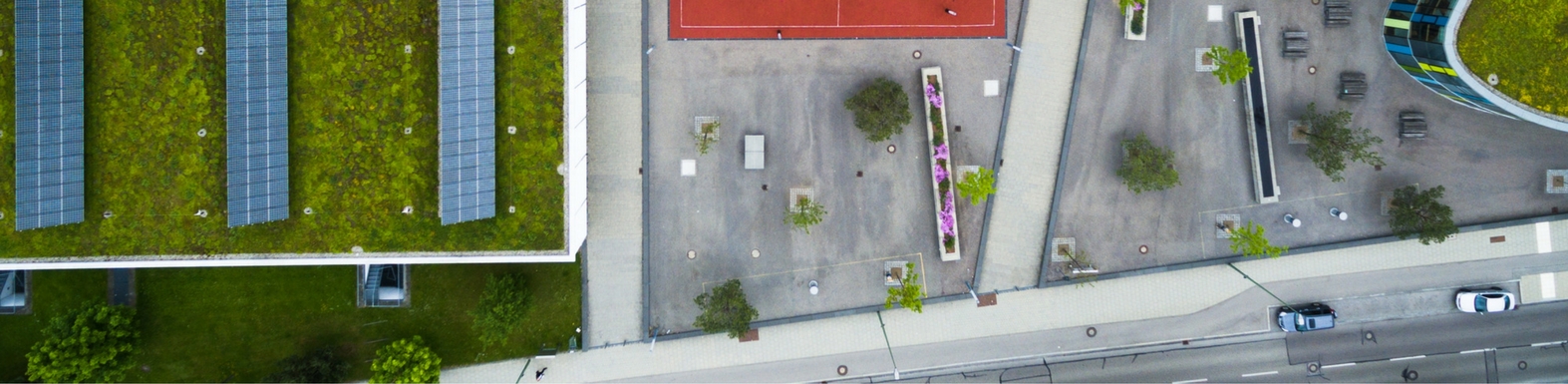
The Sanford Co-op in New Cross, South London

Last week I visited a friend of mine, Luke, who lives in a co-op in New Cross, South London. The Sanford Co-op has been around since the early 1970s and is known for its sustainable energy use and communal atmosphere.

Up until last week everyone has claimed a bike parking space next to a tree, picnic table, or various other objects. There are almost 200 people living in the flats; most have bikes.
An architect Christos Choraitis designed this beautiful and smartly designed bike “shed” to house everyone’s scattered bikes.

It is constructed out of re-used railway ties, perhaps referencing the industrial surroundings, and was built using co-op resident labor. (You can read about the planned design of this structure when it was reported in 2006). One can climb the outside and tend to the garden on top. Or, enter through the passcode-protected, swing-hinged door to access a bike.

The grand opening party was in full ride when I visited last Wednesday night and the “shed” makes for a natural gathering spot. We sat on top and enjoyed some sangria while others hung out by the vegetable/dip table set up inside. Luke and some others discovered the inside makes for a good climbing gym as well.

I was amazed by the co-op itself; not to mention Choraitis’ design. The area surrounding the living spaces is full of gigantic plants, koi ponds and raised garden beds. The co-op was bought on the cheap due to the high levels of lead in the soil (thus the raised beds).

The houses each have their own flavor and design. The kitchens were recently refurbished and each house competed to design the best slate tile pattern. I was lucky enough to join in on the party that night and crash in one of the rooms. Everyone I met was varied in their interests and nationality. But, they all seemed to appreciate bikes, traveling and enjoying life. If I don’t return to NYC it’s because I moved in here.

Setting up the Moodle

The idea to use a moodle, rather than blackboard or some other alternative, has been an on-again, off-again discussion for me for what amounts to a couple of years.

this file was named roberto for some reason

As mentioned a few days ago, I set up a moodle for my social psychology class this summer. The course starts July 13th at Hunter. If you want to look at what’s up so far, you must enrol: ourfutureenvironment.org/moodle

If you have taught social psychology or used the moodle with college students, please give me some advice!

I decided to set my moodle up just a few weeks ago (as opposed to talking about doing it) after discussing with a friend (as most ideas tend to happen) about whether we liked bluehost and what it offered compared to other hosts. I had never explored any of the extra available plugins on the bluehost c-panel, and was surprised to see they endorse/make available a moodle. Setting up a basic moodle within bluehost was a simple point and click operation.

(I briefly considered buying a new domain separate from my blog but thought keeping the two related might help me maintain my blog and moodle if this process is more transparent to students. What have other instructors done in this situation?  Are there very many out there who run an online learning environment separate from the institution?)

I would think an instructor with at least a blog, regardless of technical ability level, would be more likely to take the initiative to use a moodle within a class if he or she knew it was easy to set up and use. I know I’m being too optimistic. But, from my current work experience as a fellow in a technology and literacy program in NYC public schools, the teachers who are in their 20s to mid 30s and have been teaching only a few years are more likely than others to spend time using technology in the classroom. This translates into only the CUNY adjuncts who dislike blackboard or the commodification of education being the only ones most likely to use a moodle….

Blog posts to come:

Help, everyone thinks I’m spam!

Moodle, despite its tendency to one-sided creation, does incite creativity and interaction unheard of in blackboard. 

Ok, so its set up, now what?

a sensible quality

“…[a sensible quality, like the color blue,] which is on the point of being felt sets a kind of muddled problem for my body to solve. I must find the attitude which will provide it with the means of becoming determinate, of showing up as blue; I must find the reply to the question which is obscurely expressed. And yet I do so only when I am invited by it; my attitude is never sufficient to make me really see blue or really touch a hard surface. The sensible gives back to me what I lent to it, but this is only what I took from it in the first place. As I contemplate the blue of the sky…I abandon myself to it and plunge into this mystery, it ‘thinks itself within me,’ I am the sky itself as it is drawn together and unified, and as it begins to exist for itself; my consciousness is saturated with this limitless blue…”

merleau-ponty, phenomenology of perception, p.214

Immersive Virtual “Zoo” Environment?

The other day my good friends Michael and Gregory and I were talking about zoo environments. I said something about how when I was a child I remember the school trips to the zoo and how much I loved watching the animals’ every move. I remember learning about how flamingos are less pink when they don’t have adequate nutrition and a healthy environment.

3D Flamingos

But of course, we all agreed that zoos are less than adequate for animals. Each animal is limited on space, freedom, experience. Some call them prisoners.

I am reluctant to place ‘animals in captivity’ in an evil human actions file. Partly because I’ve been to a couple of small animal sanctuaries in Arkansas for ‘retired’ circus elephants and tigers, and racing greyhounds. The people there were needed and caring and those animals were in the best place they could realistically be. But, regardless of your viewpoint on this, the question I have is how to introduce children to animals outside of their immediate environment? Beyond watching a video or reading a book, how can a child learn to appreciate their global ecology?

The conversation led to a pondering of the existence of an immersive virtual environment. Could there be a museum of sorts that would have 3D dome IMAX rooms where one would enter in a virtual Serengeti, for example, with animals running past you, realistic temperature and wind? I can imagine this existing in  museums already. I was thinking it would be an interesting new model of ecotourism. It could eliminate travel costs and infringement upon land that most ecotours can’t avoid. And, the absence of captured animals is obviously key here.

I was investigating this online and found this article: Immersive Interactive Virtual Reality in the Museum (Roussou 2001)

Article Abstract:

“The use of immersive Virtual Reality (VR) technology is a relatively recent trend enjoyed almost exclusively by the academic, military, and industrial research and development communities. However, as VR technologies mature, research is expanding from the military and scientific visualisation realm into more multidisciplinary areas, such as education, art, culture, and the humanities. As representative institutions involved in the research and presentation of these fields, museums, cultural centres, and entertainment venues may be in a better position to make use of advanced virtual reality technologies in order to investigate their educational potential while effectively shaping how they deliver public education and recreation. This paper will discuss the issues involved in using state-of-the-art interactive virtual environments in cultural public spaces by presenting the virtual environments developed for learners of all ages at the Foundation of the Hellenic World (FHW), a cultural heritage institution of informal education located in Athens.”

The author is the director and co-founder of makebelieve. Check out their portfolio.

Lastly, Aga suggested I visit the Bartlett school while I’m in London this summer. Apparently they have a virtual ‘cave’ room for any kind of uploaded environment.

The leading question from this is whether a virtual environment design organization is working/has worked with social scientists/learning theorists  to develop an immersive, interactive “zoo”?

1999 A.D.

This video has been blogged about a couple of years ago but I just watched it via Facebook (from Matt C.). The clip below is from an “educational” 1967 film by Philco-Ford company titled 1999 A.D. The entire film shows different scenarios of how we would use technology in the future. This clip shows what could be a version of the internet. It’s conceptually not far off.

I looked up information on the company that made the film. Cause why did they make it?
From Wikipedia:
“[Philco], acquired by Ford Motor Company on December 11, 1961 and renamed Philco-Ford, continued to make many car radios for Ford vehicles as well as its other products. Eventually, the name was abandoned. Ford sold Philco to General Telephone and Electronics (who also owned Sylvania) in 1974. The Aerospace portion of Philco Ford was renamed Ford Aerospace in 1976.

The company was acquired by Philips in 1981 in order to gain the rights to use the Philips trademark in the United States. (Philco had been able to keep Philips from using its trademark legally because of the similarly sounding names.) Philips continues to use the Philco name for promotional consumer electronics and has licensed the name for private brands and retro style consumer electronics. Philips also is using the Philco brand name for digital converter boxes for analog TVs in the USA.[4] The Philco brand in this case is being licensed by Philips to Funai, who is manufacturing these boxes.”

Moodle!

I’ve installed a moodle to use for my Social Psych class this summer.

Moodle Mosaic

I hope it will augment social interaction and get some creative juices flowing. I don’t know if I’ll make a page here or not; the more visible it is the more likely I’ll get spam.

Here it is so far: www.ourfutureenvironment.org/moodle (You will have to register for an account before you can see the course).

I will blog about setting it up (here and on the Graduate Center Mac IT blog) as an alternative to blackboard and all the pros and cons so far. My class doesn’t start till July 13th; I anticipate lots of pros and cons arising then.

Suburbs minus Cars

Bikes!

“When I had a car I was always tense. I’m much happier this way,” said Heidrun Walter, a media trainer and mother of two, as she walked verdant streets where the swish of bicycles and the chatter of wandering children drown out the occasional distant motor.

Vauban, completed in 2006, is an example of a growing trend in Europe, the United States and elsewhere to separate suburban life from auto use, as a component of a movement called “smart planning.”

continue reading….

The Plight of the Maldives

The plight of the Maldives poses an eschatological question as much as an environmental one. When will the world end? How can we prepare for it? In that respect, we are all Maldivians.

Map of the Maldives

The islanders just happen to be among the first groups to contemplate these questions seriously. But that’s not to say each and every Maldivian spends his or her day preoccupied with sea levels. Ahmed Abbas, one of Nasheed’s longtime friends and the political cartoonist for the magazine Sangu, told me that Nasheed was overreacting. “We have been here for 3,000 years,” Abbas said as we drank espressos and ate ice cream one afternoon at a cafe in Malé. “Coral is our base. If one millimeter of water comes up, then one millimeter of coral goes up, too. So don’t worry.” His response was downright flippant when the conversation turned to a looming exodus: “Why don’t we all just board a barge? Anni” — Nasheed’s nickname — “can be the captain!” Nonetheless, Abbas was flying the next day to Sri Lanka, where he said he hoped to scout a tract of hillside property for himself.”


Click through for Times Article

End the University as We Know It?

Reposting a Times Op-Ed today by Mark C. Taylor.

“……

If American higher education is to thrive in the 21st century, colleges and universities, like Wall Street and Detroit, must be rigorously regulated and completely restructured. The long process to make higher learning more agile, adaptive and imaginative can begin with six major steps:

1. Restructure the curriculum, beginning with graduate programs and proceeding as quickly as possible to undergraduate programs. The division-of-labor model of separate departments is obsolete and must be replaced with a curriculum structured like a web or complex adaptive network. Responsible teaching and scholarship must become cross-disciplinary and cross-cultural.

Just a few weeks ago, I attended a meeting of political scientists who had gathered to discuss why international relations theory had never considered the role of religion in society. Given the state of the world today, this is a significant oversight. There can be no adequate understanding of the most important issues we face when disciplines are cloistered from one another and operate on their own premises.

It would be far more effective to bring together people working on questions of religion, politics, history, economics, anthropology, sociology, literature, art, religion and philosophy to engage in comparative analysis of common problems. As the curriculum is restructured, fields of inquiry and methods of investigation will be transformed.

2. Abolish permanent departments, even for undergraduate education, and create problem-focused programs. These constantly evolving programs would have sunset clauses, and every seven years each one should be evaluated and either abolished, continued or significantly changed. It is possible to imagine a broad range of topics around which such zones of inquiry could be organized: Mind, Body, Law, Information, Networks, Language, Space, Time, Media, Money, Life and Water.

Consider, for example, a Water program. In the coming decades, water will become a more pressing problem than oil, and the quantity, quality and distribution of water will pose significant scientific, technological and ecological difficulties as well as serious political and economic challenges. These vexing practical problems cannot be adequately addressed without also considering important philosophical, religious and ethical issues. After all, beliefs shape practices as much as practices shape beliefs.

A Water program would bring together people in the humanities, arts, social and natural sciences with representatives from professional schools like medicine, law, business, engineering, social work, theology and architecture. Through the intersection of multiple perspectives and approaches, new theoretical insights will develop and unexpected practical solutions will emerge.

3. Increase collaboration among institutions. All institutions do not need to do all things and technology makes it possible for schools to form partnerships to share students and faculty. Institutions will be able to expand while contracting. Let one college have a strong department in French, for example, and the other a strong department in German; through teleconferencing and the Internet both subjects can be taught at both places with half the staff. With these tools, I have already team-taught semester-long seminars in real time at the Universities of Helsinki and Melbourne.

4. Transform the traditional dissertation. In the arts and humanities, where looming cutbacks will be most devastating, there is no longer a market for books modeled on the medieval dissertation, with more footnotes than text. As financial pressures on university presses continue to mount, publication of dissertations, and with it scholarly certification, is almost impossible. (The average university press print run of a dissertation that has been converted into a book is less than 500, and sales are usually considerably lower.) For many years, I have taught undergraduate courses in which students do not write traditional papers but develop analytic treatments in formats from hypertext and Web sites to films and video games. Graduate students should likewise be encouraged to produce “theses” in alternative formats.

5. Expand the range of professional options for graduate students. Most graduate students will never hold the kind of job for which they are being trained. It is, therefore, necessary to help them prepare for work in fields other than higher education. The exposure to new approaches and different cultures and the consideration of real-life issues will prepare students for jobs at businesses and nonprofit organizations. Moreover, the knowledge and skills they will cultivate in the new universities will enable them to adapt to a constantly changing world.

6. Impose mandatory retirement and abolish tenure. Initially intended to protect academic freedom, tenure has resulted in institutions with little turnover and professors impervious to change. After all, once tenure has been granted, there is no leverage to encourage a professor to continue to develop professionally or to require him or her to assume responsibilities like administration and student advising. Tenure should be replaced with seven-year contracts, which, like the programs in which faculty teach, can be terminated or renewed. This policy would enable colleges and universities to reward researchers, scholars and teachers who continue to evolve and remain productive while also making room for young people with new ideas and skills.

For many years, I have told students, “Do not do what I do; rather, take whatever I have to offer and do with it what I could never imagine doing and then come back and tell me about it.” My hope is that colleges and universities will be shaken out of their complacency and will open academia to a future we cannot conceive.”


Readers’ Comments


Readers shared their thoughts on this article.

Embedding the Digital into the Physical

“In the tactile world, we use our five senses to take in information about our environment and respond to it, Maes explained. But a lot of the information that helps us understand and respond to the world doesn’t come from these senses. Instead, it comes from computers and the internet. Maes’ goal is to harness computers to feed us information in an organic fashion, like our existing senses.”

From TED